Fibonacci Retracement Forex Strategy: Mastering 61.8% Pullbacks, Confluence, and Extension Targets

Fibonacci retracement is a tool used to measure where a trending market might correct before resuming its move. It projects percentage pullback zones between a clearly defined Swing High and Swing Low. Traders use these zones to identify potential reaction areas, then validate them with price action and market structure.

What is Fibonacci Retracement?

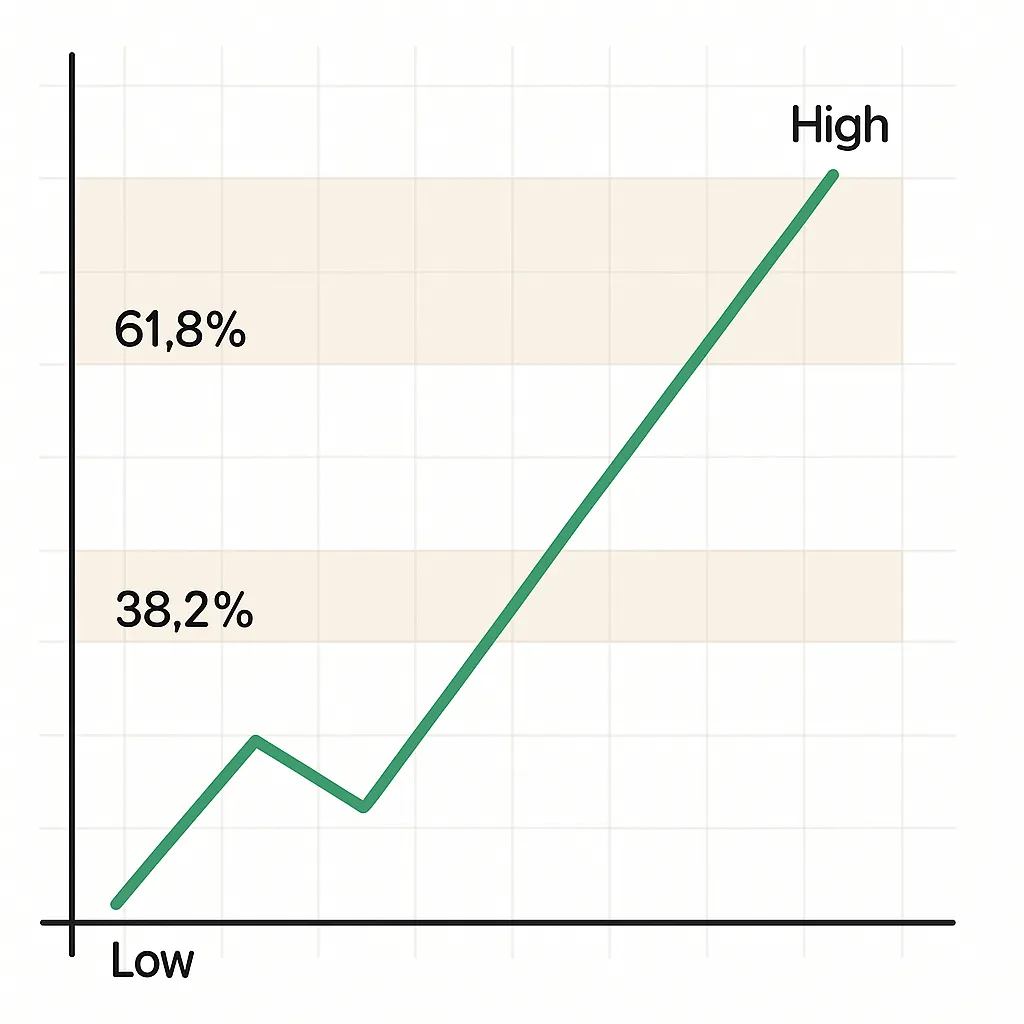
A retracement tool divides the prior impulsive leg by key ratios (for example, 38.2%, 50%, 61.8%, 78.6%) to estimate where buyers or sellers may step back in. Because price can overshoot or ignore any single level—especially during strong momentum—Fibonacci should support, not replace, confirmation from support/resistance, trendlines, and candlestick context. A Stop Loss remains mandatory on every trade.

Fibonacci retracement diagram with key levels marked

Key Fibonacci Retracement Levels

The core retracement levels most traders use are 38.2%, 50%, 61.8%, and 78.6%. Each reflects a different type of pullback behavior, risk/reward profile, and need for confirmation.

Level Typical Behavior Use Case / Notes
38.2% Shallow pullback in strong trends; momentum remains dominant. Favors aggressive continuation entries; seek strong trend confirmation.
50% Median correction; common in orderly trends. Balanced risk/reward; combine with structure and candle confirmations.
61.8% “Golden ratio” pullback; often attracts deeper dip-buying or rally-selling. High-quality zone when aligned with confluence and trend context.
78.6% Deep retracement; trend is vulnerable but not invalidated. Requires strong confirmation; smaller size or wider stops recommended.

Depth of pullback often reflects market conditions. Strong, impulsive trends commonly retrace to 38.2%–50%. Slower or corrective environments may reach 61.8%–78.6%. The deeper the pullback, the more you must demand clear validation before entry.

Fundamental Fibonacci Rules (Fib Rules Forex)

The tool’s accuracy depends on consistent application. These are the core fib rules forex traders should follow:

  • Identify swing points correctly:
    • In an uptrend, stretch the Fibonacci retracement from the significant Swing Low (the pivot from which the impulsive move began) to the subsequent Swing High (the pivot where that impulse ended).
    • In a downtrend, stretch from the Swing High to the subsequent Swing Low.
    • Swing points should be obvious on your working timeframe: a clear pivot that created a directional impulse, ideally breaking structure (e.g., higher high in uptrends or lower low in downtrends).
  • Use Fibonacci only in trending or at least structurally directional markets. In choppy ranges, retracement levels lose meaning and will produce inconsistent reactions.
  • Anchor the retracement to the most recent completed impulse. If price has already extended into a new leg and formed a new swing, update your anchors rather than forcing an outdated measurement.
  • Confirm, don’t predict. Treat each level as a potential—not a promise. Require confluence with horizontal support/resistance, trendlines, or price action signals (rejection wicks, engulfing patterns, breaks and retests).
  • Plan risk before entry. Price can slice through any level; always place a Stop Loss where your trade idea is invalidated relative to structure (not just the Fibonacci ratio).

Entry Strategy: Trading the Pullback (Fib Pullback Entry Forex)

A disciplined fib pullback entry forex plan revolves around three steps: define the trend and most recent impulse, map retracement levels, and wait for confirmation at a candidate level. The best entries occur when a pullback touches a level that aligns with structure and then prints a clear signal of rejection or continuation. The 61.8 retracement forex entry is popular because it often combines attractive risk/reward with solid mean-reversion dynamics in trends.

Your entry protocol should be consistent:

  • Determine directional bias using market structure (higher highs/higher lows or lower highs/lower lows) and break-of-structure cues.
  • Anchor your retracement: Swing Low to Swing High in uptrends, or Swing High to Swing Low in downtrends.
  • Select candidate levels in advance (for example, 61.8% as primary, 50% as secondary).
  • Require proof of buyers or sellers returning: a rejection wick, an engulfing candle, or a break-and-retest of a minor intraday structure near the level.
  • Define your invalidation point and position size before placing the order.

The Golden Ratio Entry (61.8% Retracement Forex)

The 61.8% level, derived from the golden ratio, often marks the zone where countertrend participants take profit and trend participants re-enter. It is deep enough to improve reward-to-risk (because stops can be tucked behind the swing or the 78.6%) yet not so deep as to imply a trend failure by default.

Why traders use it in practice:

  • Order flow equilibrium: After an impulse, mean reversion often pulls price into the 50%–61.8% region, where unfilled orders and profit-taking collide.
  • Liquidity sweep: Pullbacks that pierce through 50% can test stops near mid-impulse thresholds, which may support a continuation move from the 61.8% area.
  • Cleaner invalidation: If price trades significantly beyond 61.8% and especially beyond 78.6%, the prior impulse is vulnerable, offering an objective line in the sand.

Execution tips:

  • Wait for a confirming candle pattern or micro break-and-retest around 61.8%.
  • If momentum into the level is strong, consider scaling entries (partial at 61.8%, add only if confirmation appears).
  • Place the Stop Loss beyond the 78.6% or the swing point to account for noise.

Trading the 38.2% and 50% Levels

Shallow pullbacks (38.2%) occur in strong trends where buyers or sellers step in early. These entries are more aggressive and typically require tighter confirmation and strong momentum context. The 50% level, while not a Fibonacci ratio mathematically, is a widely respected midpoint of many impulses.

Approach guidelines:

  • Favor 38.2% entries when the trend is clearly impulsive (large candles, shallow dips, consistent structure). Consider confirmation on a lower timeframe to refine risk.
  • Use 50% when the trend is steady and pullbacks are orderly. Look for a confluence zone—prior swing high/low turned support/resistance, a micro trendline touch, or a cluster of wicks.
  • Because shallow entries offer less clearance for stops, consider placing stops beyond the next deeper level (e.g., beyond 50% when entering at 38.2%), or wait for a break-and-retest to reduce false starts.

Confirmation: Trading Fibonacci Confluence (Fib Confluence Forex)

Confluence is what elevates Fibonacci from a measuring tool to a tradable strategy. The term fib confluence forex refers to aligning a retracement level with other independent signals—horizontal support/resistance, trendlines, moving averages, or session-based context—to improve the quality of the setup. When multiple independent factors point to the same price area, reactions are often clearer.

Principles for building confluence:

  • Horizontal first: Identify major swing highs/lows, weekly/daily levels, and proven intraday pivots. These levels define where the market has previously accepted or rejected price.
  • Structural second: Add trendlines parallel to the trend or channel boundaries that have at least two clean touches.
  • Fibonacci third: Overlay retracement levels only after mapping structure, using them to refine an already credible zone rather than to invent one.
  • Confirmation final: Execute only after a clear reaction—wicks rejecting the zone, engulfing patterns, or a break-and-retest of a micro level.

Fibonacci + Support/Resistance (Fib + Support Resistance Forex)

Horizontal levels are the bedrock of market structure. When a Fibonacci retracement aligns with a proven historical level, the area often attracts a sharp reaction because multiple trader groups are focused there. This is the most common and effective form of confluence because it marries a predictive tool with observable market memory. To formalize it, label your key horizontal zones first, then note which Fibonacci levels overlap. This is the essence of fib + support resistance forex: use Fibonacci to refine a pre-existing level, not to create it.
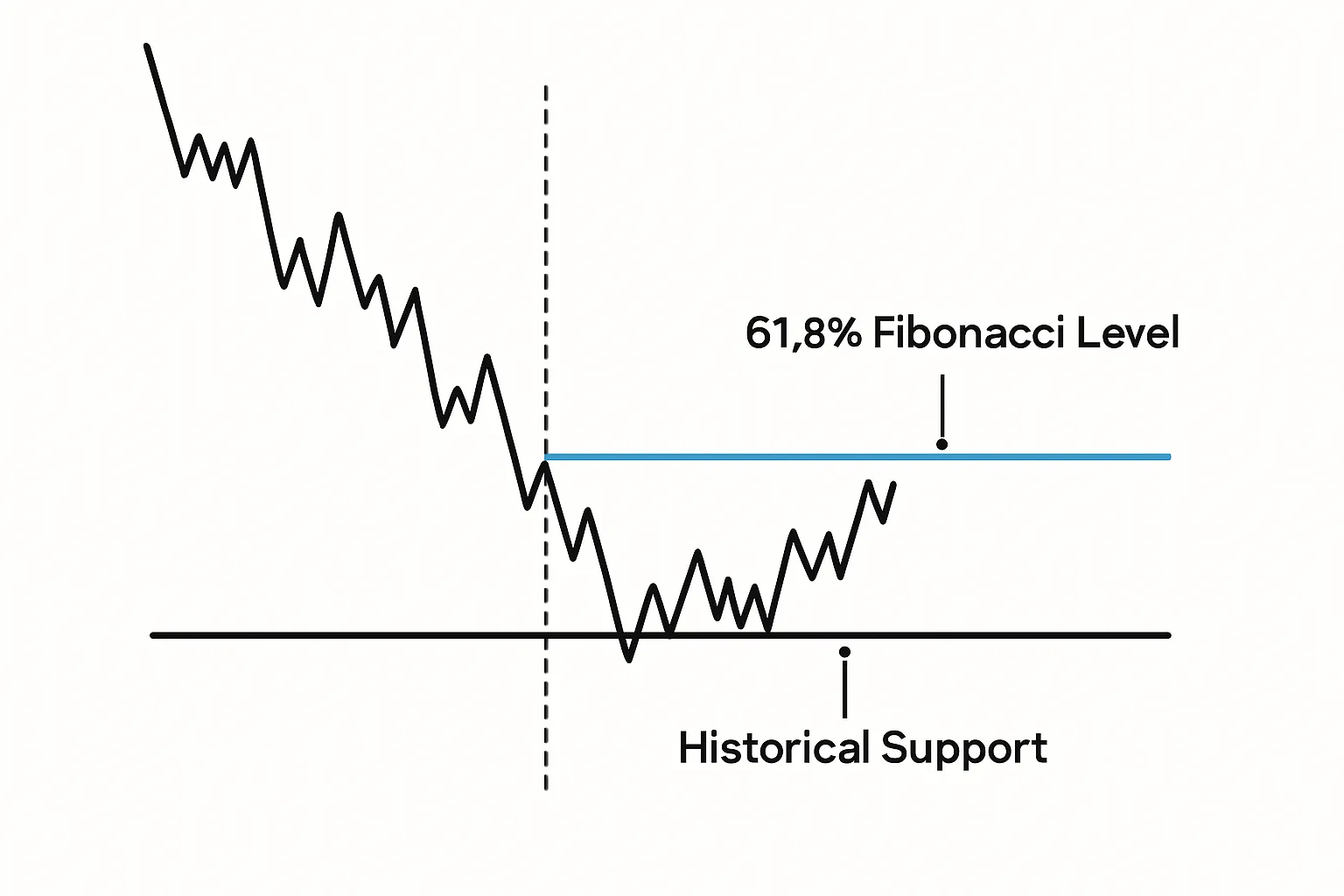
Fibonacci confluence diagram highlighting support level

Execution notes:

  • Prefer multi-touch levels on higher timeframes for importance (e.g., a daily support with several reactions).
  • Look for compression into the level (tight ranges, diminishing volatility) before the touch; the breakout/reject behavior becomes clearer.
  • Use price action to confirm: a long lower wick at support or an engulfing candle closing away from the zone.

Fibonacci + Trendline (Fib + Trendline Forex)

Trendlines (or channels) provide dynamic structure and context to pullbacks. When a retracement level coincides with a tested trendline, the zone gains credibility from both horizontal ratios and diagonal structure. This fib + trendline forex confluence is especially helpful in steady, orderly trends where price respects the channel boundaries.

Execution notes:

  • Validate the trendline with at least two clean touches before relying on it.
  • Prefer alignment within a channel where the opposite boundary offers a logical target.
  • Combine with a confirming candle at the touch to rule out a trendline “pierce and continue” scenario.

Exit Strategy: Fibonacci Extension Targets (Fib Extensions Targets Forex)

Your targets and stops define the strategy’s edge as much as your entry. The fib extensions targets forex approach uses extension levels—projections beyond 100% of the measured impulse—to set objective take-profit zones. After the pullback completes and price resumes the trend, extensions such as 127.2% and 161.8% offer structured exit points that are consistent across instruments and timeframes.
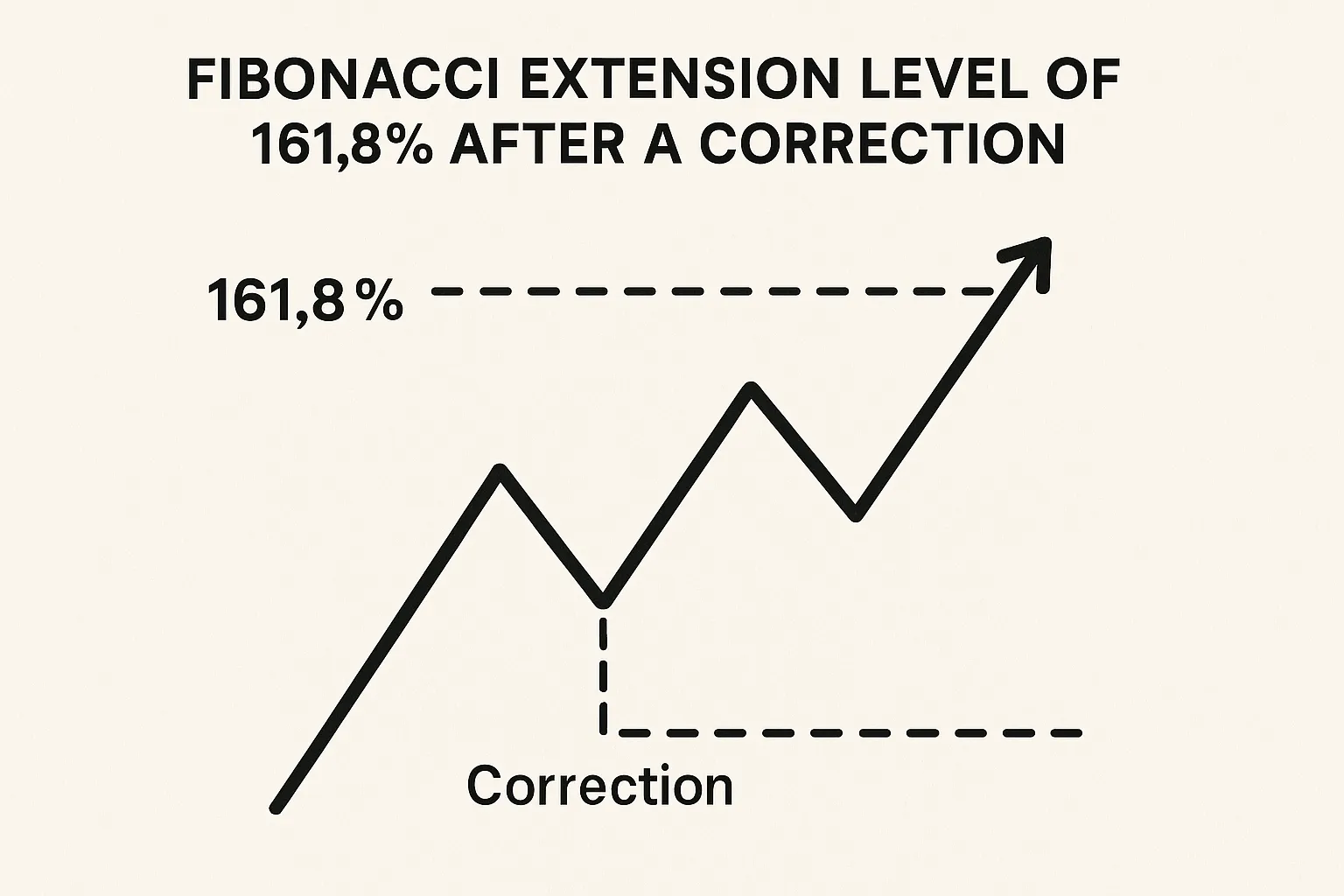
Fibonacci extensions diagram showing profit target

Setting Take Profit with Extensions

Extension levels translate the magnitude of the prior impulse into forward targets. To project them, use the same swing anchors you used for the retracement:

  • In an uptrend, anchor from Swing Low to Swing High. After the pullback, the 127.2% and 161.8% levels become logical take-profit zones above the prior high.
  • In a downtrend, anchor from Swing High to Swing Low. After the rally (pullback), extension targets project below the prior low.

Target selection:

  • 127.2% is conservative and often reached in average trend continuations.
  • 161.8% is more ambitious, typically achievable in strong momentum runs or when higher timeframe structure supports continuation.
  • If a key horizontal level lies just before your extension, consider front-running the target to avoid stalling risk.

Trade management:

  • Scale out partially at 127.2% to bank gains and let the remainder aim for 161.8%.
  • If price accelerates strongly, trail a stop behind higher lows/lower highs or use a moving average to lock in profit while allowing room for trend continuation.
  • Avoid moving targets mid-trade without fresh structural evidence; consistency is key to assessing performance over time.

Stop Loss Placement with Retracements

Stops protect both capital and strategy integrity. Place them where the setup is objectively invalid:

  • Conservative stop: beyond the 78.6% retracement, giving the trade room to breathe while maintaining the thesis that the pullback remains corrective.
  • Structural stop: beyond the Swing Low (in long setups) or Swing High (in shorts). This confirms that if taken out, the prior impulse structure is likely compromised.
  • Volatility-aware sizing: consider recent candle ranges to avoid placing stops inside normal noise.

Risk management principles:

  • Always predefine risk per trade (for example, 0.5%–1% of equity).
  • Accept that any Fibonacci level can fail; do not widen stops after entry without a clear, rules-based reason.
  • If confirmation is weak or momentum into the level is strong, reduce size or pass on the trade.

Applying Fibonacci to Different Styles

Fibonacci adapts well across trading styles, provided you scale expectations to volatility and timeframe. Swing traders often use higher timeframes (H4/D1) to define swings and then refine entries on H1/M30. Intraday traders apply the same logic to smaller structures, recognizing that noise increases and levels can be probed more frequently. Regardless of style, the hierarchy is constant: establish the trend, map structure, add Fibonacci to refine zones, and seek confirmation before execution.

When conditions change—such as during news releases or thin liquidity—retracement reactions can be less reliable. In those cases, either stand aside or require stronger confluence and tighter confirmation before committing capital.

Fibonacci for Day Trading (Fib Day Trading Forex)

For intraday traders, fib day trading forex emphasizes speed, clarity, and discipline. Lower timeframes (H1/M30) can produce multiple impulses and pullbacks within a session, but they also introduce false breaks and whipsaw risk.

Practical guidelines:

  • Define the session bias early using pre-London or pre-New York structure. Anchor your retracements to the clearest impulse that breaks intraday structure.
  • Favor the 38.2%–50% zone in strong, trending sessions and the 50%–61.8% zone in slower or overlapping sessions.
  • Use lower timeframe confirmations (M15/M5) at the level: rejection wicks, engulfing candles, or a break-and-retest of a micro pivot.
  • Be news-aware. Major releases can invalidate levels quickly; either avoid trading into releases or re-confirm after volatility subsides.
  • Manage trades actively: partial at 127.2%, trail stops behind clear intraday swing points, and accept that quick invalidations are part of the intraday edge.

Conclusion: The Power of the Fibonacci Tool

Used correctly, the fibonacci retracement forex strategy offers a consistent framework for planning entries, stops, and targets within trending markets. The tool’s value lies in forecasting potential correction zones and projecting realistic objectives—not in predicting reversals by itself. The most reliable reactions arise from confluence: Fibonacci aligned with horizontal support/resistance, trendlines, and clear price action confirmations. Pair that with rigorous risk management—accepting that any level can fail, using mandatory Stop Losses, and sizing trades conservatively—and you have a methodical, repeatable process. Treat Fibonacci as an auxiliary component inside a larger market-structure plan, and it can meaningfully improve clarity, timing, and consistency across trading styles and timeframes.

Ready to Automate Your Forex Trading?
Launch your AI-powered automated forex strategy in minutes with a simple, seamless broker connection.
The website elirox.com and Mobile application are owned and operated by ELIROX LLC. The company Elirox LLC is registered under registration Number: 3582, with the registered company address at Suite 305, Griffith Corporate Centre, Beachmont, Kingstown, Saint Vincent and the Grenadines. The commercial name of the company is “Elirox”. The services offered by this Website and Mobile application can be executed only by fully competent adults.
© Elirox, 2025
Download the Elirox app
Become a partner